|
|
| Hermine Server Learn more about What we need Features Roadmap Releases |
|
|
|
Need more informations about Hermine Server? Ask for it. |
|
|
| Last update: 12/08/07 |
|
|
|
 |
||
|
Here you'll learn something more about what Hermine Server is. Applications usually have two different kinds of organizing they data: a linear list or hierarchical tree. A linear list is often used when there is a list of homogeneous data, like addresses or goods. Hierarchical trees are used to structure data that depending on each other like organizations, the way from country over state, city to street. But modern kind of data needs a more efficient way of organizing data, something what is more knowledge based, more semantics. Hermine Server is a collection of services all about the management of meta knowledge. That means the following. Everything we know, everything we learn is based on a structure. This structure might be very complex and it is almost hidden and it has to be because would it be apparently it might be to much for our brain and memory. But sometimes we missing this structure. Mostly when we are looking for something. Seeing this structure or parts of it may be helpful to find something what is by meaning close to or near by. But how to find something what we do not know exactly? How to find the colour between red and yellow when we know only red and yellow. Meta maps of knowledge will help you to identify about what you are looking for and that is what Hermine Server and the collection of services is for.
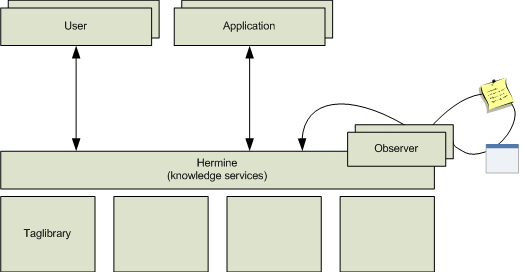
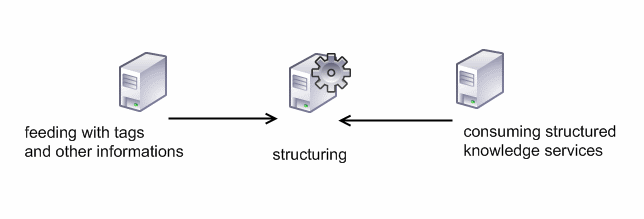
How it worksIn short, Hermine analyses data and tries to find relations between terms and represent it in different ways. The target is to find meta information about what is around. The input of data might come in two ways. The first one is an interface for putting terms directly into the service. That's almost interesting for using it as a part of a SOA architecture where other services may feed Hermine Server with terms and other kind of data. The second one is the use of observers. Observers are agents that looking for data by themselves. Data might be everything readable (in the current version) like textfiles or database or something like this.
Who can use itActually we aimed it as an part of a SOA infrastructure. Therefore currently the main scenario are companies who wants to complete they SOA infrastructure with a server helping to find things better in they data. Even it is ready to use it might be just helpful when it is fited for individuell needs like individual observers for indivdual data.
|
||